

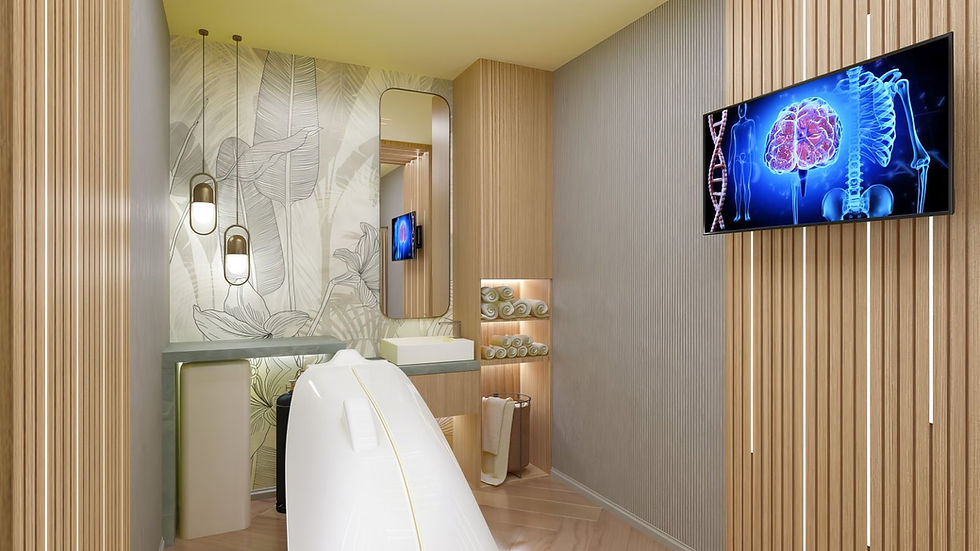
NOVUS THERMAL REGULATION ENVIRONMENT
Integrated biophysical environment for induced thermal adaptation, vasodynamic activation and systematic regulation of internal metabolism. The module is a multi-layered closed environment in which controlled hyperthermia, gas transdermal environment, photon stimulation, pulse electromagnetic dynamics and oxygen modulation are synchronously combined in order to influence the physiological conduction and adaptive capacity of the body.
Within the NuCELL NOVUS system, the module is not considered as an isolated procedure, but as: a regulatory input medium for system physiological readjustment.


With a controlled increase in thermal load, the following is observed:
- vasodilative activation
- change in microcirculatory dynamics
- enhancing tissue metabolism
- increasing transmembrane activity
- activation of elimination mechanisms
- alteration in autonomic neurovegetative reactivity
The synchronized combination between thermal, photonic and electromagnetic environments creates conditions for:
- increased tissue oxygenation
- transient metabolic hyperactivation
- accelerated physiological fluid rotation
- increased lymphodynamic flow
- optimization of cell metabolism
The function of the module in the operational architecture of NuCELL NOVUS is:
- to increase the adaptation reserve
- prepare the internal environment for subsequent modules
- to increase physiological reactivity
- optimize system conductivity and exchange processes
CONTROLLED ADAPTIVE STRESS ENVIRONMENT
That is, a controlled environment in which the organism is temporarily taken out of its baseline homeostatic state in order to activate a higher level of regulation and physiological mobilization.
How the procedure works:
The session in the NOVUS THERMAL REGULATION ENVIRONMENT usually lasts about 30 minutes, and the parameters are adapted to the physiological profile, adaptation reserve and goals of the particular person.
The procedure goes through several successive regulatory phases, in which the thermal environment, gas dynamics, photon stimulation and electromagnetic parameters are superimposed in a controlled sequence in order to gradually increase physiological reactivity.
The initial phase is aimed at:
- vasodynamic activation
- expansion of microcirculatory capacity
- preparation of the skin and vascular surface for the subsequent layers of impact
The medium then switches to more intensive thermoregulatory and gas modulation, in which the following are activated:
- the hyperthermic regime
- transdermal gas environment
- photon dynamics
- PEMF parameters
- oxygen maintenance
- Individually selected neurophysiological settings
Within NuCELL NOVUS, the settings are not used according to a standard template, but are changed according to:
- the degree of physiological load
- adaptation capacity
- the state of the autonomic nervous system
- circulation dynamics
- lymphatic stasis
- recovery needs
- the level of metabolic reactivity
- the overall objective of the integrative protocol
Depending on the specific protocol, the following can be modulated:
- thermal intensity
- the duration of the individual phases
- electromagnetic dynamics
- photon stimulation
- oxygen maintenance
- the degree of physiological activation
The procedure is used both in more adaptive and regulatory modes, and as a more intensive preparatory layer before the integration of the other modules into the NuCELL NOVUS system.
Within NuCELL NOVUS, this module does not function as a standalone technology, but as part of a larger integrative architecture developed by Albina Fabiani, a system in which individual environments, modules and regulatory layers are combined in a controlled sequence in order to optimize physiological adaptation, internal metabolism and overall functional efficiency of the organism.